Movies sometimes grow out of the soil of destinies, epics, memories, and sometimes History itself.
The screenplay of Cotton Queen, Suzannah Mirghani’s first feature film, emerged from the soil of Sudan.
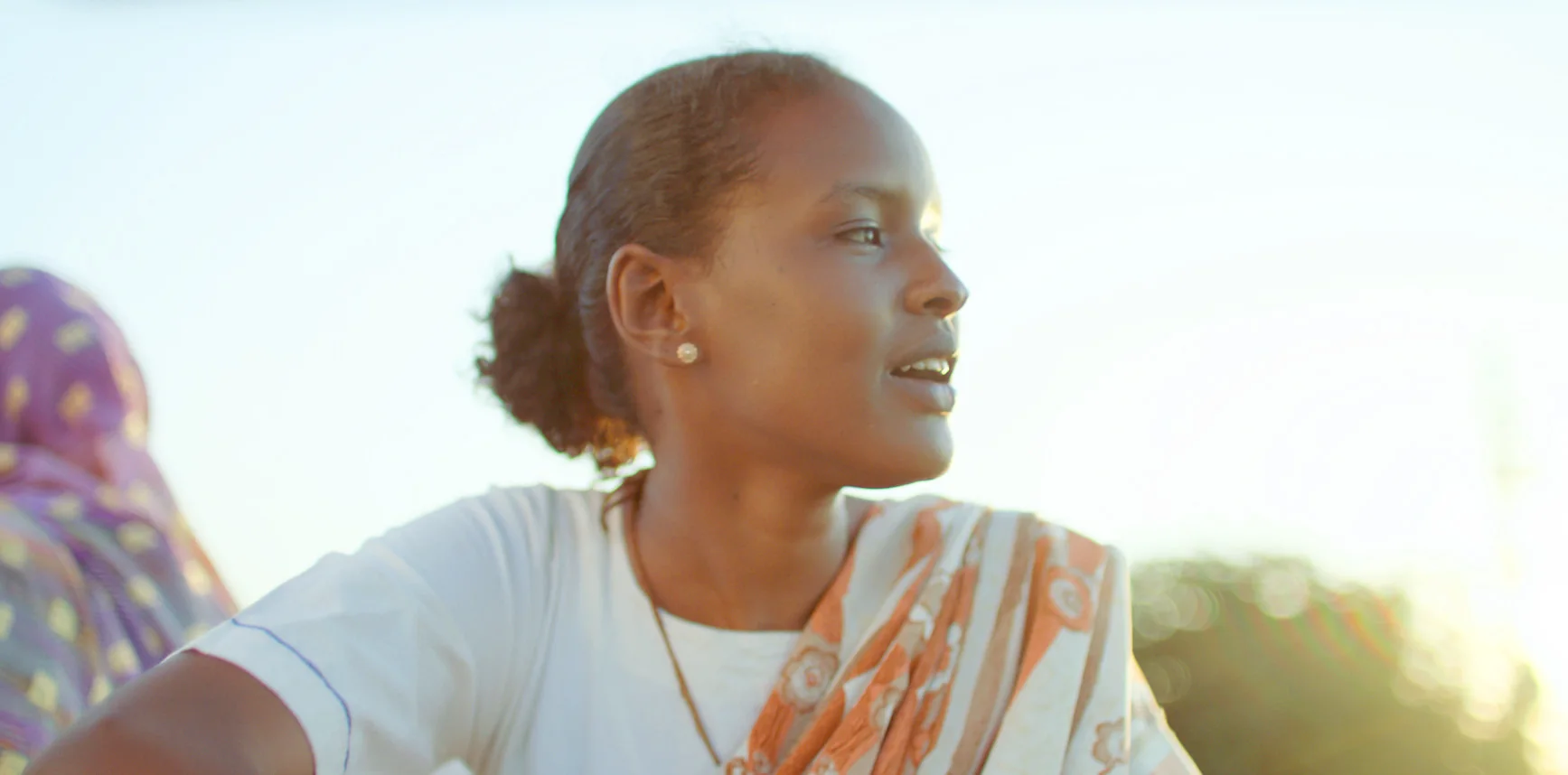
And yet this is a work that does not merely tell the story of a country, it summons its ghosts, its scents, its wounds and its legends. The movie takes place in a cotton-growing village, where Nafisa, fifteen years old, grows up under the magnetic authority of her grandmother Al-Sit, a respected matriarch and guardian of an ancient world. The arrival of a young businessman from abroad, carrying a development project built around genetically modified cotton, disrupts the fragile balance of this community. Nafisa suddenly finds herself at the center of a field of forces far beyond her years: tradition, money, the body, territory, marriage, inheritance.
To reduce Cotton Queen to its political subject would be to miss its true movement. The movie does not proceed like a manifesto. It proceeds like a dream. A dream sometimes calm, sometimes feverish, often pierced by unsettling images, in which reality becomes charged with signs. Nafisa is not merely passing through a social conflict, she is passing through an age of life when everything becomes symbolic.
Cotton is not simply a raw material.
It is memory.
A softness that has known violence.
A vegetal whiteness carrying within it the history of colonialism.
A wealth that others still seek to tear away from the women who cultivate it.
In Cotton Queen, beauty is never innocent. It is a force, a promise, and sometimes a currency. Nafisa is looked at, assessed, projected into a future that others would like to write for her. Her destiny seems capable of becoming a transaction: familial, economic, symbolic.
And yet the grace of the movie lies in this: Nafisa is never only an object. Even when she appears trapped, something in her resists. A thought lights up. A refusal takes shape. A power begins to reveal itself.
Al-Sit, the grandmother, a central and almost mythological figure, embodies another form of female power. Her authority comes from a past the film allows to rise to the surface with restraint. One senses that her body, her former beauty, her scars, her secrets, have all been instruments of conquest and survival. For her, independence is nothing abstract: it is inscribed in the skin, in the possession of land, in the way she holds another person’s gaze. Al-Sit belongs to that rare order of characters who seem to have paid for every parcel of freedom they possess. Nafisa, in turn, inherits not only an estate, but a question:
How can one become free without reproducing the violence that allowed yesterday’s women to survive?
This is where the movie becomes fascinating. It does not simply oppose modernity and tradition. The capitalism that arrives in the village in the form of a polite, rational, seductive entrepreneur is no obvious liberation. It promises progress, yet carries within it another form of subjugation: seeds that germinate only once, dependency organized as a system, dispossession presented as opportunity. Tradition, meanwhile, is not idealized either. It preserves an order, but that order can wound girls, control their bodies, close down their futures. Mirghani therefore films a double threat: that of the old world when it hardens and that of the new one when it advances beneath the mask of development.
Color, in Cotton Queen, is never decorative. It seems to come from the earth itself: from cotton, water, skin, fabric, dust, from that Sudanese light which makes each frame feel both concrete and slightly unreal. The movie possesses an almost hallucinatory visual sensuality. The fields are not merely places of labor; they become mental spaces. The bathing scenes are not merely moments of rest; they open a parenthesis of grace, sisterhood and unease. As for the old house with its English resonances, it seems to carry within its walls the memory of a colonial world that has never entirely disappeared.
At times, one thinks of a Pre-Raphaelite imagination displaced to Sudan: not through visual imitation but through a shared tension between nature, morality, beauty and vertigo. The Pre-Raphaelites wanted to reconcile the eye, the conscience, memory, and the heart.
Cotton Queen seems to pursue a neighboring ambition but from another soil, another history, another wound. Nature here is not merely a setting. It is a language. Bodies in water, fabrics, glances, gestures of labor, the presence of cotton: everything seems to belong to a world in which beauty is still capable of revealing a moral truth.
The figure of Ophelia then passes through the film like a possible shadow. Nafisa in the boat, the water surrounding her, madness threatening, beauty suspended between surrender and revolt: Shakespeare is not cited but something of his myth seems to return.
Except that here, the young girl is not merely condemned to float in the gaze of others. She is looking for a shore. She is looking for a voice. She is trying to understand what part of her destiny still belongs to her.
This may be the movie’s greatest delicacy: making us feel that emancipation is not a slogan, but an intimate tremor. Nafisa does not become free in a single gesture. She awakens in fragments, through intuitions, fears, visions. The filmmaker builds around her a political tale in which domination does not come from one place alone. It can come from men, from family, from the market, from traditions but also from forms of female power inherited from an older world. This complexity prevents the film from becoming simplistic. Female power here is not pure; it is ambivalent, transmitted, sometimes harsh. It exists. And that is already immense.
Presented at Venice Critics’ Week, Cotton Queen also belongs to a moment in which Sudanese cinema is gaining precious international visibility. The movie had its world premiere in Venice in 2025 and is scheduled for release in France on July 1, 2026.
Its production also bears the marks of recent history: the shoot, initially connected to Sudan, had to be moved to Egypt because of the Sudanese civil war. This gives the film an added emotional force: the Sudan being filmed is already, in part, a dreamed Sudan, a displaced Sudan, a recreated Sudan, a Sudan saved by cinema.
Cotton Queen is a movie of passage: from childhood to consciousness, from myth to history, from apparent submission to inner power.
A gentle and ferocious movie.
A solar and troubled dream in which a Sudanese girl, facing men, ancestors, merchants and ghosts, learns to belong to no one.