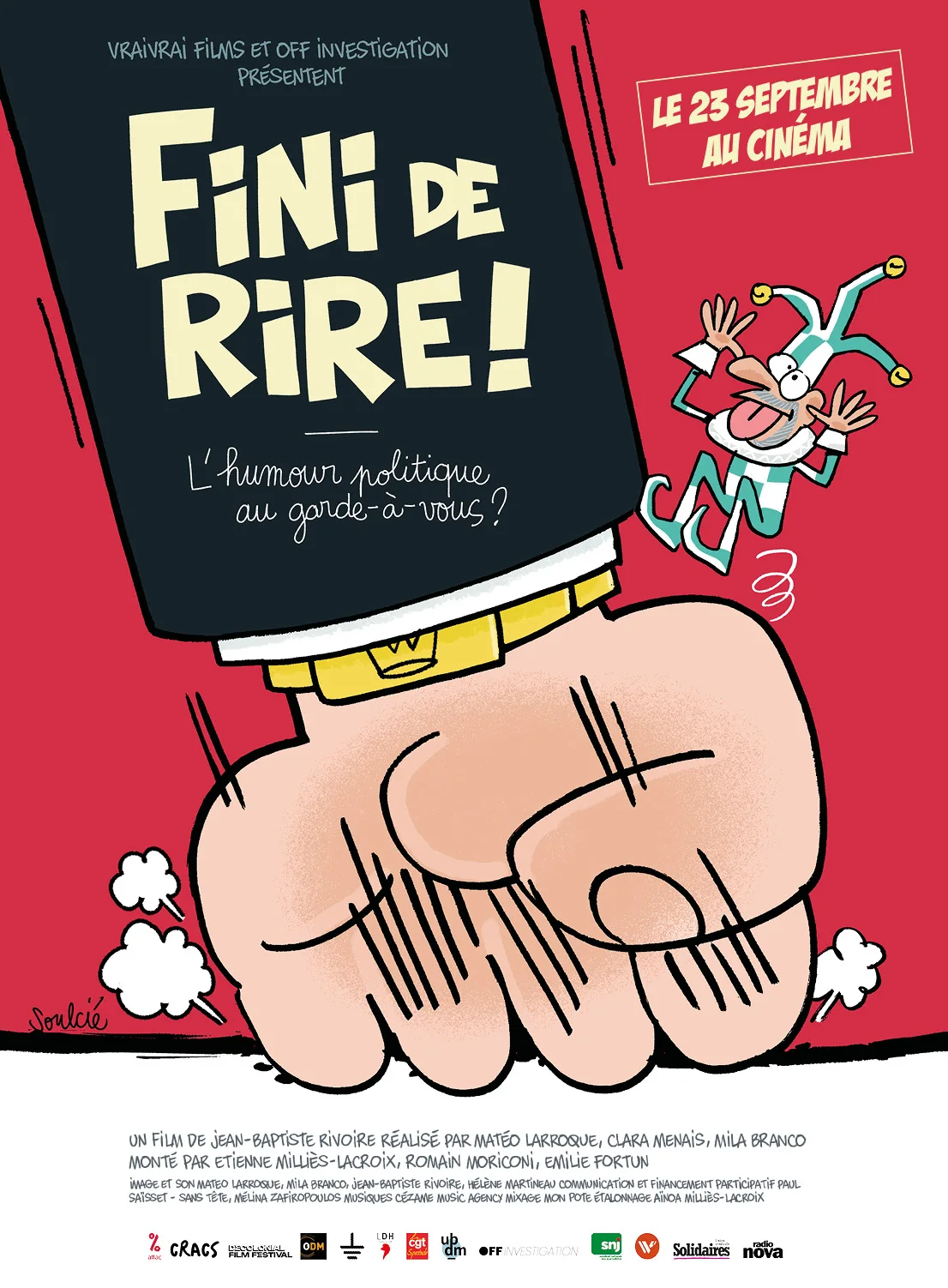
Fini de rire! - When the Powerful Stop Laughing
The Jester and the Big Screen
The first question raised by Fini de rire! is almost disarmingly practical: what is an OFF Investigation documentary doing in a cinema theater ?
OFF Investigation belongs, in our contemporary imagination, to the browser window, the phone propped against a coffee cup, the video sent to a friend with the accompanying injunction: You need to watch this. Cinema still requires something rather more ceremonial: leaving the house, arriving at a particular hour, watching a door close behind you, and sitting among a hundred strangers who have agreed increasingly, a minor miracle to look at the same thing at the same time.
And this is precisely where the film becomes interesting.
The ninety-seven-minute investigation by Jean-Baptiste Rivoire, directed by Matéo Larroque, Clara Menais and Mila Branco, traces what it sees as three decades of a gradual retreat of political satire from French broadcasting, from Les Guignols de l’info to Guillaume Meurice, by way of France Télévisions and France Inter.
For OFF Investigation, this is the first inquiry conceived to reach cinemas before appearing online. In doing so, it rather unexpectedly rediscovers one of cinema’s oldest purposes: transforming an affair of the moment into a collective experience.
The choice is hardly incidental. By September 4th, the official website was already announcing the participation of more than a hundred independent cinemas.
Once Upon a Time, There Was “l’esprit Canal”
One perhaps had to know Canal+ before the “+” began to resemble a financial operation more than a promise of something extra to appreciate the faint vertigo running through this film.
There was a time when a subscription television channel made irreverence part of its commercial identity.
Les Guignols, Nulle part ailleurs, parodies, détournements, writers who appeared to have been instructed to mock first and perhaps apologise later: together they formed what the French referred to, with a charmingly disproportionate solemnity, as l’esprit Canal , the Canal spirit.
The documentary naturally summons veterans of that lost world, Bruno Gaccio, Sandrine Alexi, Yves Le Rolland, Lionel Dutemple, Daniel Herzog, rather as one might interview the survivors of a civilisation in which a puppet was still permitted to be more insolent than its owner.
This is not merely nostalgia.
Following Vincent Bolloré’s takeover of Canal+ in 2015, the place occupied by Les Guignols was progressively reduced before the programme disappeared altogether in 2018. Bolloré had notably accused the show of an “excess of mockery.”
Apparently, then, ridicule comes with a recommended dosage, beyond which a shareholder may begin to experience adverse effects.
It is at this point that Fini de rire! ceases to be a history of television and becomes a history of power.
The Fourth Estate Does Not Require a Conspiracy
We like to speak of the “fourth estate” as though it were something remembered from a civics textbook.
The documentary reminds us that it is first and foremost an infrastructure: frequencies, studios, capital, appointments, owners, prime-time schedules.
There is no need to imagine twelve cigar-smoking men plotting in a back room. Modern power is usually more ordinary than that.
It draws up the schedule.
The question raised by the film is not whether an owner telephones every morning to dictate each sentence spoken on air. Such vulgarity would almost be reassuring.
The more important question is what happens when economic concentration, editorial direction and political interest gradually begin looking in the same direction.
The debate now extends well beyond the film itself.
In September 2026, Reuters described CNews, owned by Vincent Bolloré’s group, as having become a central platform for radical-right and far-right discourse in the run-up to France’s 2027 presidential election. Reporters Without Borders had previously documented significant disparities in the exposure afforded to different political tendencies, as well as an unusually intense concentration on immigration, crime, Islamism and questions of identity.
None of this requires pretending that the far left does not exist, that the left has no blind spots of its own, or that only one political family knows how to manipulate language.
The more interesting development lies elsewhere:
a part of the French radical right now possesses an industrial media infrastructure capable not merely of commenting on the agenda but of helping manufacture it.
And that changes rather a lot.
We Have Worn Our Words Threadbare
Our political vocabulary increasingly resembles an overprinted currency.
“Fascist.” “Woke.” “Far left.” “Racist.” “Antisemitic.” “Censorship.” “Totalitarian.”
The words circulate so frantically that they sometimes cease to mean quite what they once did.
It may be one of the more revealing sociological ailments of our age.
Concepts that once helped distinguish one phenomenon from another have become projectiles designed to end conversations. Whoever names the enemy first appears to have won.
When every contradiction becomes “violence,” every criticism “hatred,” and every sanction “censorship,” we gradually lose the ability to recognise violence, hatred and censorship when they actually occur.
The comedian ought to be one of the antidotes to this inflation.
The job, after all, is to take a pin to our grand lexical balloons.
Which is perhaps why people become so irritated with comedians.
Fascism Does Not Always Enter Wearing a Uniform
We should be precise here.
France in 2026 is not Germany in 1933.
Any analogy that erased the distinction would be historically lazy and morally indecent.
But history offers another lesson, subtler and perhaps more useful: authoritarian regimes do not necessarily arrive one morning fully assembled, complete with uniforms, banners and ominous music.
They proceed piece by piece.
After the Nazis came to power in Germany in 1933, freedom of expression and of the press was progressively dismantled through laws, decrees and the subordination of cultural institutions.
A Reich Chamber of Culture ultimately supervised cinema, theatre, radio, journalism, literature and the visual arts.
By 1934, as the United States Holocaust Memorial Museum has documented, joking about Hitler could itself be regarded as an act of treason.
The lesson is not: we are there.
The lesson is: watch the sequence.
By the time the brown shirts become impossible not to notice, much of the institutional work has already been completed.
Chaplin Knew That Tyrants Hate Being Made Small
Cinema has its own sacred relic on the subject.
In 1940, before the United States had even entered the war, Charlie Chaplin dared to make The Great Dictator.
Hitler became Adenoid Hynkel: gesticulating, narcissistic, grotesque, dancing with a globe as though the world were a toy ball belonging to a petulant child.
Chaplin understood something essential:
caricature strips power of its metaphysics.
One may fear a dictator.
It becomes rather more difficult to revere him after watching him slip on the proverbial banana peel.
The Cinémathèque française describes The Great Dictator as a fierce satire of Nazism made before America’s entry into the war.
Twelve years later, amid the anti-Communist atmosphere of the United States, Chaplin was deprived of his re-entry permit, in part because of his political positions. He settled in Switzerland and did not return to America for twenty years.
None of this makes every dismissed comedian a Chaplin.
It merely reminds us that comic artists have long performed a function authoritarian societies sometimes understand more clearly than democracies do:
they reduce the symbolic size of powerful men.
From Washington to Hollywood
Nor does this reflex belong exclusively to France, or even to one side of the Atlantic.
Donald Trump has long treated television hosts and comedians as public adversaries.
In 2026, he was again calling for Jimmy Kimmel to be fired and urging regulatory intervention against broadcasters whose programmes displeased him. Disney, for its part, launched proceedings against the FCC, arguing that accelerated reviews of ABC station licences amounted to political retaliation. The FCC disputes that interpretation.
The case remains ongoing.
These distinctions matter.
A president complaining about a comedian, a corporate decision, regulatory pressure and legal censorship are not interchangeable phenomena.
But when a head of state publicly calls for professional punishment against comedians who mock him, curiosity seems the very least a democracy should be able to muster.
A few years earlier, Hollywood had provided another image, infinitely less political, yet strangely unforgettable.
At the 2022 Academy Awards, Chris Rock made a joke. Will Smith crossed the stage and slapped him before an audience of millions.
The Academy subsequently banned Smith from its events for ten years.
To compare a slap at the Oscars with government censorship would, of course, be absurd.
Yet as a cultural metaphor, the image remains difficult to shake:
the jester speaks and, instead of answering him, the powerful man descends upon him.
Even Our Aesthetics Have Turned Beige
There may also be an aesthetic counterpart to this new caution.
Our age has developed an extraordinary fondness for greige.
The apartments are greige.
The cafés are greige.
The hotels are greige.
The interfaces are greige.
Restaurants across the world now appear to contain the same round lamp, the same polished concrete and the same faintly anxious eucalyptus branch standing in a vase.
Why should public speech have escaped the trend?
The ideal show becomes the one from which no thirty-second clip could possibly cause an emergency meeting.
The ideal joke is polished until it no longer possesses an edge.
The ideal artist is daring within the boundaries stipulated by the contract.
Eventually, culture becomes decoration.
Cinema becomes “content.”
And the court jester is given a lifestyle segment.
This may be one of the more unsettling things Fini de rire! tells us, sometimes despite itself: political normalisation and aesthetic normalisation are close relatives.
Both dream of a world without splinters.
Or, more troublingly still, a world in which one splinter, that of the far right, has become so familiar that one scarcely feels it anymore.
Even If a Comedian Can Be Wrong or Simply in Bad Taste
The film is stronger if it is watched with the same freedom it demands for its protagonists.
The joke Guillaume Meurice made about Benjamin Netanyahu was regarded as appalling even by some fellow comedians.
Complaints alleging incitement to hatred and antisemitic insult were dismissed by prosecutors in Nanterre. Radio France, meanwhile, cited “repeated disloyalty” when it terminated his contract after he repeated the joke. Arcom had also issued a warning to Radio France.
It is precisely this complexity that deserves discussion.
With the benefit of hindsight, was ending his contract justified?
What, exactly, does “loyalty” mean in such a context? Loyalty to an employer? To editorial standards? To the thinking of management?
Generally speaking, a joke can be bad without requiring the disappearance of the person who told it.
An employer may have editorial responsibilities without becoming a Ministry of Good Taste.
Freedom of expression does not guarantee anyone an eternal right to a microphone.
But audiences matter, too and these comedians had audiences.
Satire is not sacred.
It can be cruel, lazy, obscene or simply unsuccessful.
Certain wounds, certain beliefs and certain private griefs deserve an intelligent understanding of context.
But tact must not become a veto belonging to the powerful.
What Is a Clown For?
Every civilisation seems to have invented some version of this peculiar creature who is permitted to tell the sovereign what nobody else dares say.
The court jester was not merely decorative.
He served a purpose.
Religions themselves know the paradox.
Institutions often become very fond of prophets once the prophets are dead.
They are considerably less enthusiastic about the prophetic function while it is alive, noisy and pointing towards the hypocrisy of power.
The comedian belongs, in some small way, to that tradition.
He does not possess the truth.
He interferes with the staging of it.
And sometimes that is enough.
So Why the Cinema?
At last, the choice of the movie theatre becomes obvious.
In a darkened auditorium, laughter is no longer a metric.
It travels.
Someone begins in the third row.
Another person resists.
Then the room gives in.
Here, the move into the cinema also functions as a warning of something more immediate: the possibility of a cinema rendered tasteless, bland, sanitised, safe enough to offend no one and perhaps alive enough to interest no one either.
Algorithms separate us into audiences.
The cinema puts us back into a room.
And that may be why Fini de rire! belongs on the big screen more than one initially suspects.
Its real subject is not simply political comedy.
It is the possibility of a collective response to a collective danger.
A democracy cannot be judged solely by the freedom enjoyed by those who approve of it.
It must also be judged by the degree of insolence it is capable of enduring without calling security.
There is no need to describe every editorial decision as fascist.
Indeed, doing so would be dangerous: use the word for everything and, eventually, we may fail to recognise it when it becomes necessary.
But it is no more sensible to wait for uniforms before beginning to worry.
Between hysteria and complacency lies something rather less spectacular:
vigilance.
And perhaps a few clowns.
Fini de rire! arrives in cinemas as a warning, but also as an invitation:
let us laugh while laughter still has teeth.