The shift rather than the shock
For a long time, horror evolved through visible cycles:
the paranormal wave of the 2010s,
the return of folk horror, then the resurgence of the gothic.
What is emerging today is more discreet,
less spectacular, more insidious.
The mechanism is no longer that of shock, with its familiar narrative machinery.
Instead, we observe a mechanism of drift,
a dissolution of the ordinary into an unsettling strangeness.
We are faced with a cinema that does not impose itself but infiltrates,
that does not strike but persists.
Some already refer to it as liminal horror.
One might translate it, without truly betraying it, as a cinema of thresholds.
It is not a genre in the classical sense,
but a sensation.
That of a space meant to be passed through
which, suddenly, holds us.
Poor frames, rich fear
At first glance, nothing appears spectacular:
a corridor,
a subway station,
a room that is too empty.
And yet, these images carry a singular density.
They recall less the language of cinema than the contemporary experience of the digital world:
endless wandering, aimless clicking, doomscrolling, getting lost within an invisible architecture.
It is no coincidence that this aesthetic was born online before finding its way into theaters.
Cinema, once again, absorbs our lived experience, our reality, and transforms it.
The movies to come : the emergence of a territory
What was once diffuse is now taking on a clearer form.
Two movies, in particular, seem to crystallize this movement:
Backrooms, produced by A24 and directed by Kane Parsons, extends a legend born on the internet :
that of an infinite space made of identical rooms, where reality appears to have slipped out of place.
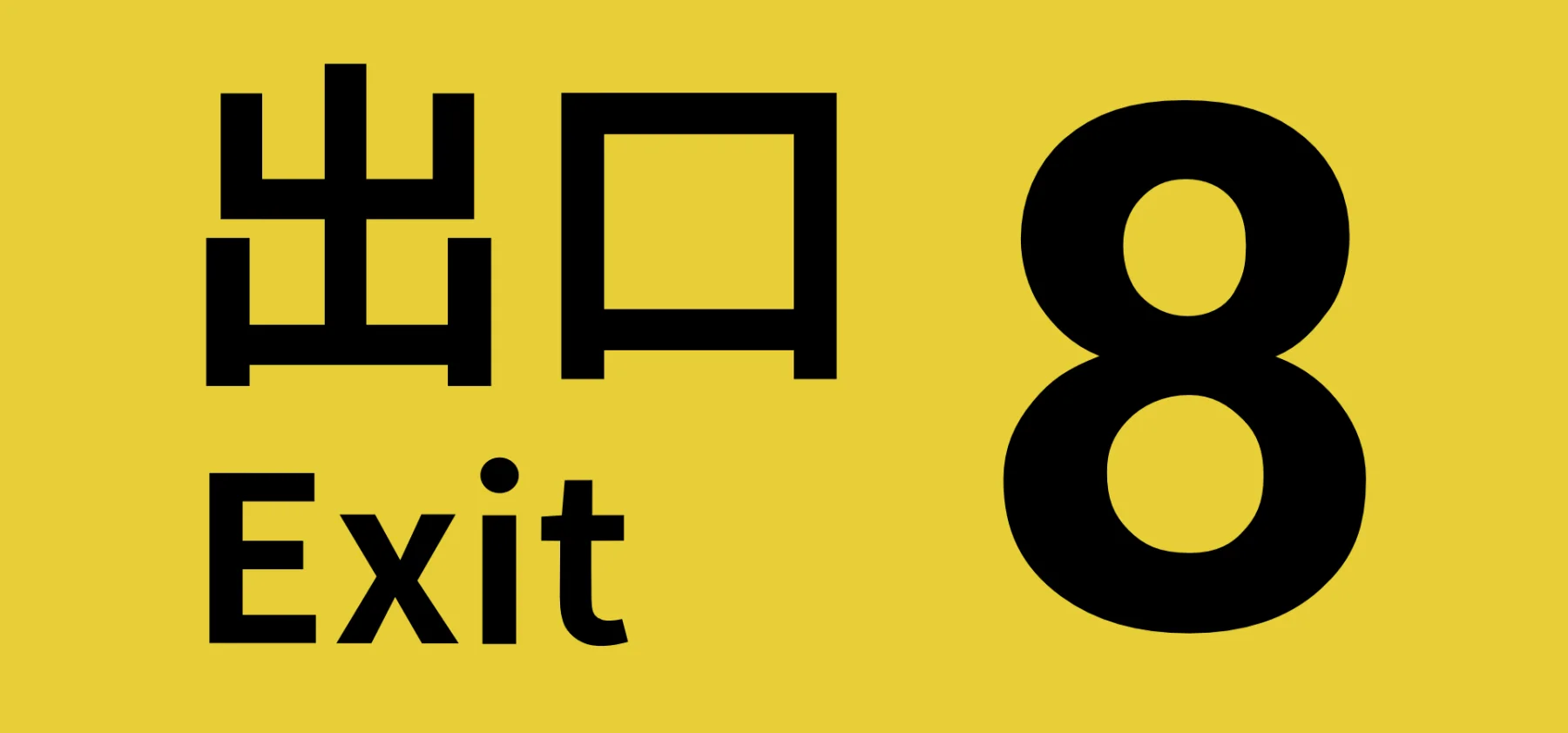
Exit 8, distributed by Neon and inspired by the game by Kotake Create, follows a passenger trapped in an endless subway system, where every detail becomes suspect.
Here, horror does not rely on creatures or events
but on repetition, on waiting, on barely perceptible anomalies.
These are no longer narratives, they are experiences.
Cinema had already opened the way
This territory is not entirely new.
It already existed, in latent form, in certain films.
In REC by Jaume Balagueró and Paco Plaza, space gradually closes in, the building becoming an autonomous entity of horror.
In 28 Days Later by Danny Boyle, the empty city is not merely post-apocalyptic : it seems suspended outside of time.
In Megan Is Missing by Michael Goi, horror emerges within early online discussion spaces, still unregulated, where vigilance dissolves.
In Tesis by Alejandro Amenábar, the apparatus of the camera itself already generated unease, while revealing an early intuition of what our relationship to images would become.
These films do not belong to threshold horror
but they contain its matrix.
A fractured reality
What defines this movement is that it no longer seeks to invent another world.
It begins with ours
and shifts it, just slightly.
A subway that never ends.
A corridor that repeats itself.
A house that no longer leads outside.
Nothing is spectacular.
Everything is unstable,
as if reality itself had begun to fracture.
A horror born of our time
This cinema speaks directly to our moment:
a fatigue with overly explicit images
a distrust of spectacle
an attraction to blurred, unstable zones
But above all, it reflects an experience:
that of a world saturated with in-between spaces,
physical, digital, psychological.
We inhabit these transitional spaces.
Cinema is beginning to remain within them.
An economy of unease
There is also, in the background, a quieter logic.
These films are:
low-cost
formally open
radically accessible
They do not rely on an abundance of visual effects but on ideas.
On framing.
On duration, on time, on rhythm.
What we are witnessing is yet another mutation of horror cinema,
an ideal form for an independent cinema in search of renewal.
What comes next
This movement may well redefine horror in the years to come.
Not through excess
but through subtraction.
Fewer monsters.
More presence.
Less explanation.
More sensation.
Less narrative.
More drift.
Horror cinema may no longer be where we expect it.
Today, horror may no longer lie in what appears
but in what we can no longer control : reality itself.
It slowly slips away from us,
beyond any possibility of reclaiming it.