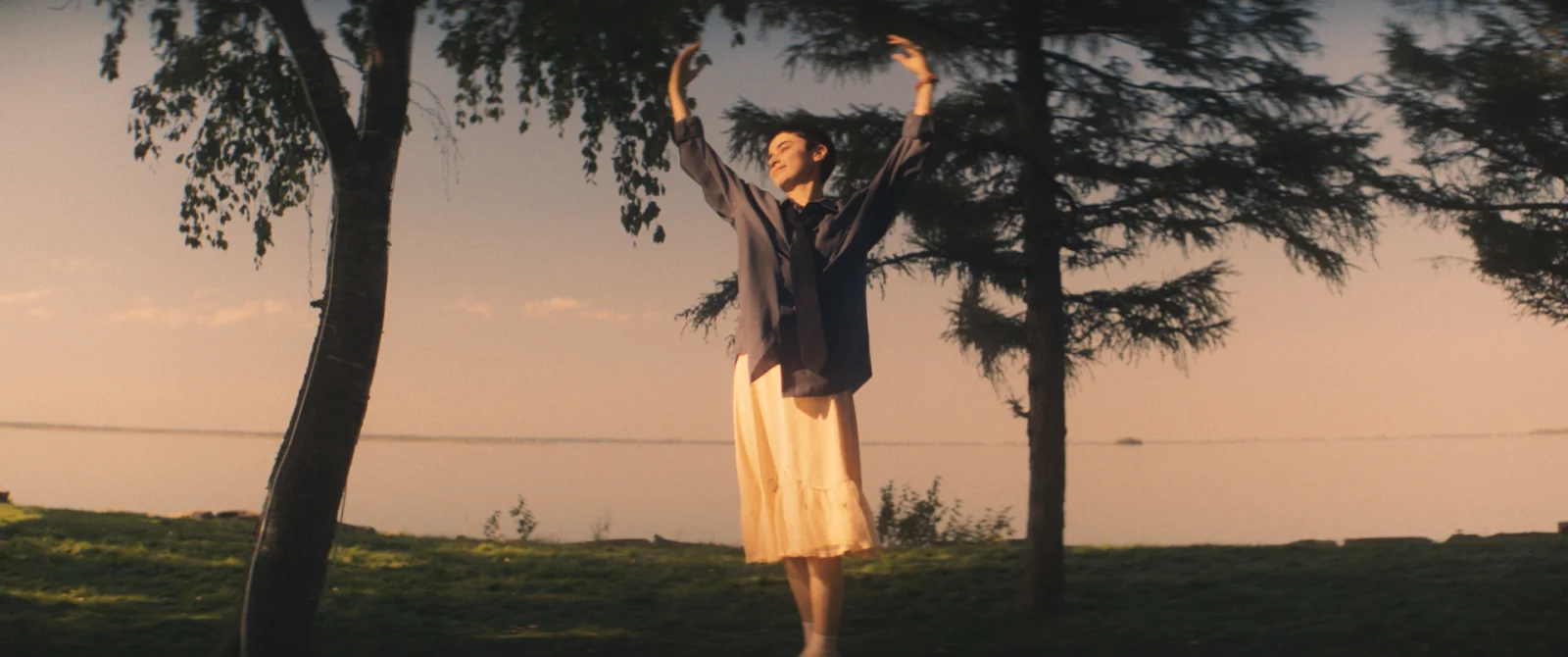
Eighteen, or the Future in the Conditional
At eighteen, one should ordinarily be entitled to choose the wrong haircut, believe that a three-week passion will last forever, enrol in the wrong degree and later call the whole thing “an experience.”
One should have the luxury of wasting time.
Anna no longer does.
In Où vont les âmes, Brigitte Poupart’s first fiction feature, the young woman requests medical assistance in dying and gives herself fifteen days to reunite with her two half-sisters before her death. They have been estranged for four years, since their father’s trial. And so begins a countdown whose conclusion is revealed to us almost immediately.
Anna is going to die.
The question, then, is not really: what is going to happen?
It is much harder:
What are we going to do with the time that remains?
That may be the film’s first great strength: the way it quietly shifts its subject.
Medical assistance in dying could, on its own, fill three opinion columns, five television panels and several family dinners that become inexplicably hostile before dessert.
Poupart prefers a house.
Women.
A lake.
And fifteen days.
The debate suddenly becomes an experience.
Dying Before Life Has Begun
Anna’s illness is devastating because it does not simply take years away from her.
It takes away first times.
The journeys she will never make. The lovers she will never know. The absurd mornings after a party. Break-ups, reconciliations, the first apartment that costs too much, perhaps a child, perhaps no child at all — but at least the right to choose.
The tragedy of dying very young may lie less in the amount of life that is lost than in the immensity of the life left hypothetical.
Anna already possesses enough of an adult gaze to understand what she is being denied, but not enough of a past to console herself with.
It is an almost cruel position: old enough to measure the absence, too young to have had time to fill it.
Sara Montpetit plays that contradiction with remarkable delicacy.
Anna does not constantly ask the audience to pity her.
Thankfully.
She still wants to provoke, seduce the world, make images, exist.
She wants to die and she still wants to live.
The two sentences contradict one another.
That is precisely why they can both be true.
Instagram at the Bedside
Anna also watches her own disappearance through social media.
The idea could easily have become a lazy comment on a generation that films everything, including itself.
The film is subtler than that.
Social media is both wonderful and poisonous here.
It gives Anna an outside world when serious illness has reduced hers to rooms, treatments, appointments and people asking, with excessive caution, whether she is “doing O.K.”
It allows her to be looked at as something other than a patient.
To make.
To compose.
To turn her condition into an image.
Her sisters, however, also see the danger: the exposure of a family intimacy that may not entirely belong to Anna, the possibility of turning tragedy into public material, even the potential consequences of her posts for their father’s legal situation.
This is where the film grasps something very contemporary.
We invented extraordinary tools against loneliness.
Then we gave them a “Publish” button.
The algorithm knows nothing of anticipatory grief or discretion.
It knows engagement.
Three Sisters, Three Ways of Surviving
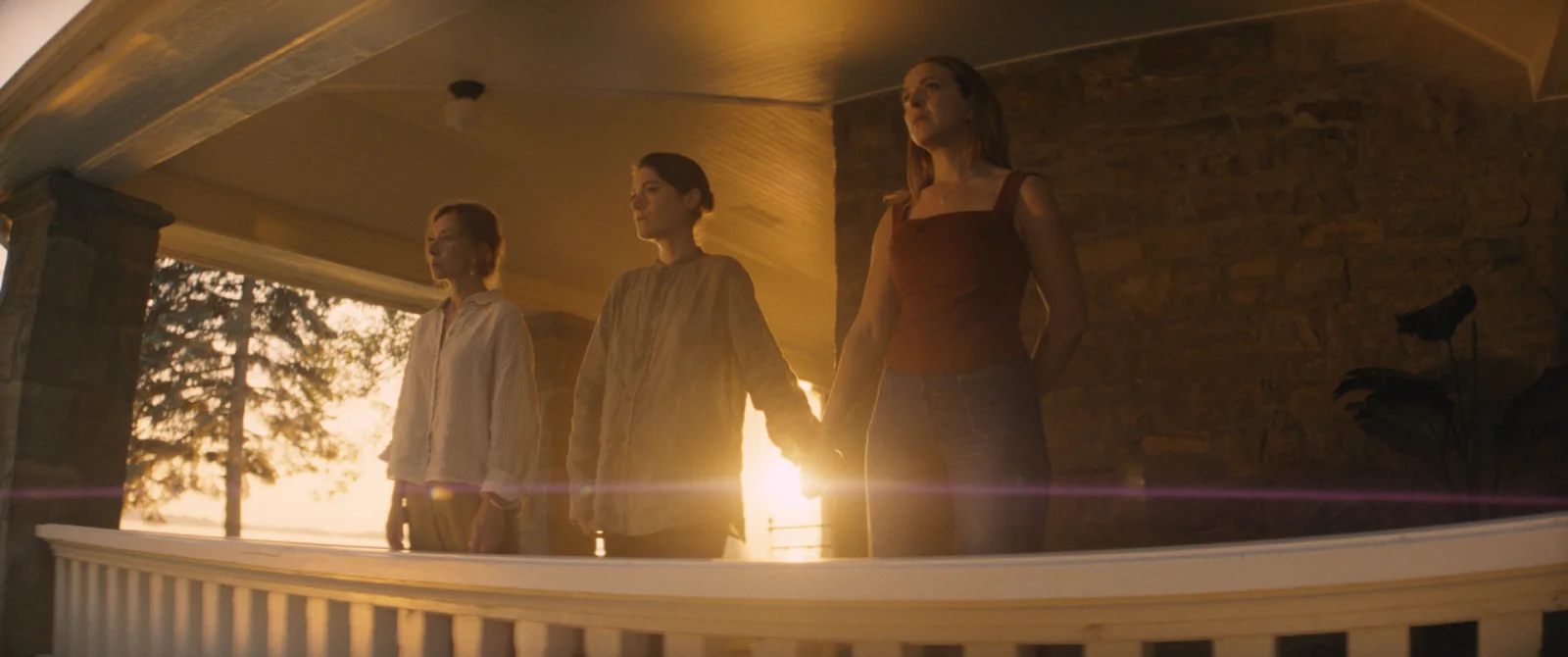
But Où vont les âmes finds its true heart in the sisters.
They do not respond to illness as some tidy emotional unit called “the family.”
Each brings her own history, temperament and anger.
And that feels much truer.
Ève, played by Monia Chokri, possesses an almost abrasive freedom, a way of inhabiting her femininity and her relationship to seduction as something that no longer necessarily requires anyone’s permission.
Éléonore, played by Julianne Côté, works more through restraint and observation, a certain distance that is not an absence of love so much as perhaps one of its survival mechanisms.
Anna, meanwhile, occupies the impossible position of being both the youngest sister and the person around whom everyone must now reorganise their relationship to death.
They move closer.
They collide.
They begin again.
The sisterhood in this film is not a slogan.
The Father Who Is Not There
And yet a man dominates Où vont les âmes.
We barely see him.
It is probably one of Brigitte Poupart’s most interesting decisions.
The father, convicted of sexual violence, remains mainly a voice, an abstract presence whose consequences are entirely concrete.
His absence becomes a representation of patriarchy through its visible effects.
The three sisters have not, moreover, constructed the same account of their father - something that recalls, in spirit, the fractured nature of testimony in Akira Kurosawa’s Rashomon.
One condemns him.
Another looks for the possibility of forgiveness.
Anna herself resists accepting his guilt.
Here again, the film allows for something intelligent and uncomfortable: a family does not necessarily produce a single truth from the same event.
It produces several memories.
Sometimes incompatible ones.
Loving someone who has done harm does not absolve what they have done.
Sylvie Testud, or the Art of Not “Playing the Mother”
We say that Sylvie Testud is “just right” so often that it is easy to forget how difficult that quality actually is.
With some actresses, grief arrives accompanied by familiar signposts.
With Testud, it seems to have taken a seat quietly at the back of the room, only to reveal itself when one least expects it.
She plays Stéphanie, Anna’s mother, a woman who must confront her daughter’s decision while enduring the accusations surrounding what she accepted, tolerated or refused to see in her own marriage.
Testud restores to her the privilege of contradiction.
Around her, Sara Montpetit, Monia Chokri and Julianne Côté form something like a shared nervous system.
The film depends on their unforced precision.
Entertain You?
Où vont les âmes is not a pleasure film.
It is not especially dynamic.
It does not wish to be.
Its 121 minutes unfold with the awareness of a countdown that no one can accelerate without betraying the subject.
The choice asks something of the viewer.
Some will experience it as delicacy.
Others as slowness.
Both responses can coexist.
The plot is the waiting for death.
Which is considerably less spectacular.
Who Is Really Choosing?
The film becomes politically interesting precisely because, for the most part, it refuses to become political in the television sense of the word.
A young woman asks to die.
The temptation is immediate: turn her into a case.
For.
Against.
Permitted.
Forbidden.
Moral.
Immoral.
But behind the principles there are bedrooms, mothers, sisters, and pain with very little interest in opinion polls.
Poupart worked with a doctor who practises medical assistance in dying, and the words spoken during the final procedure are those actually used.
That does not make the film neutral.
No film truly is.
But it returns the choice to its most difficult location: a body, a consciousness, the people nearby.
Spiritual, religious and philosophical considerations obviously have their place in the debate.
But they become different once we have spent two hours living alongside these women.
The Right to Die and the Obligation to Remain
This may be where Où vont les âmes becomes most perceptive.
The decision belongs to Anna, but its consequences belong to other people too.
That is an uncomfortable truth.
We like to imagine the great choices of contemporary life through individual autonomy: my body, my existence, my decision.
That autonomy is essential.
But no human being is perfectly autonomous.
Anna chooses.
Her sisters must learn to accept a choice they did not make.
Her mother must accompany her towards the very place every maternal instinct is telling her to prevent.
Where Do Souls Go?
The title asks a question the film is wise enough not to answer.
Where do souls go?
Religion has several proposals.
Philosophy has some too.
Algorithms will presumably offer a subscription plan soon enough.
A house.
A piano.
Videos.
A horse’s saddle.
Clothes.
A sister remembering a sentence.
A mother who may never know whether she did enough.
Anna’s death is at the centre of the film.
And yet, paradoxically, Où vont les âmes ends up speaking mostly about life.
Anna will not have all her first times.
That may be what hurts most.
This is not an easy film.
It is not always a comfortable one.
And that may be precisely why it deserves the time it asks of us.